


Alzheimer's disease (AD) is a quietly invading neurodegenerative disease, whose pathological changes begin decades before cognitive symptoms appear. How to monitor AD early in a simple and economical way has become an urgent need in the medical community. On June 28, 2024, the journal ACS Nano published a breakthrough study completed by Fujian Medical University in collaboration with the National Center for Nanoscience and Technology and other institutions, entitled "Microarray Chip-Based High-Throughput Screening of Neurofilament Light Chain Self-Assembling Peptide for Noninvasive Monitoring of Alzheimer's Disease". This study developed a high-throughput screening method and successfully screened out the self-assembling peptide Pep-NfL targeting neurofilament light chain (NfL), providing new hope for non-invasive monitoring of AD. This article will reveal the highlights of this study for you, with a special focus on the key contributions of gold sheets, silver sheets and Plexera HT instruments.
01 Research Background
As the population ages, the number of AD patients is expected to surge in the coming decades. However, current treatment options are limited, and clinical trials have repeatedly failed, partly due to the lack of early and accurate biomarker detection methods. NfL, a marker that increases in the blood and cerebrospinal fluid more than a decade before the onset of AD, is considered a "star player" for monitoring the progression of AD. However, traditional single-molecule array (Simoa) technology is difficult to be widely used in clinical practice due to its high cost. Therefore, the research team took a different approach and developed a high-throughput screening system based on microarray chips, with the goal of finding a low-cost, high-sensitivity NfL detection method.
02 Research Highlights
The research team used the "one-bead-one-compound" (OBOC) peptide library, combined with microfluidics and microarray technology, to screen out a self-assembling peptide for NfL, Pep-NfL. This peptide not only has extremely high binding affinity (KD=1.39×10⁻⁹mol/L), but also exhibits excellent specificity and low cost. Pep-NfL performed well in AD mouse models and cell lines, and successfully distinguished AD patients (n=37, P<0.001), mild cognitive impairment (MCI) patients (n=26, P<0.05) and healthy controls (n=30) in clinical samples. This achievement provides an important tool for non-invasive monitoring of AD progression and evaluation of disease-modifying therapies.
03 Key contributions of gold and silver sheets and the Plexera HT instrument
The success of this research is inseparable from advanced instruments and technical support, among which gold sheets, silver sheets and surface plasmon resonance imaging (SPRi) instruments played an irreplaceable role.
04 Gold and silver sheets: the core substrate of microarray chips
The microarray chips used in the study are based on gold and silver sheets. The silver sheets are prepared by sputtering technology and are used to carry the resin beads in the OBOC peptide library to achieve "single bead single well" capture. The gold sheets are used for SPRi detection to directly fix the screened peptide array. The high stability and surface characteristics of these two chips ensure the precise arrangement and high-density presentation of peptide molecules, avoiding the problem of nonspecific adsorption in traditional antibody detection, thereby improving the detection sensitivity.
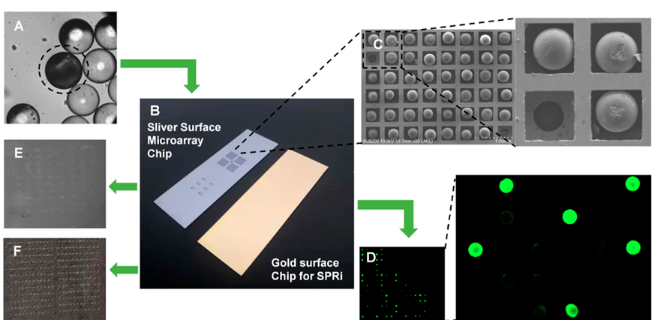
Figure 1b-Silver microarray chip and gold SPRi chip. Figure 1c-SEM image of single bead single well capture.
Figure 1e-SPRi microarray on gold slide.
05 Plexera HT instrument: the “eagle eye” of affinity screening
Plexera HT measured the binding affinity of Pep-NfL to NfL in a real-time, label-free manner. The research team used SPRi to compare the binding abilities of six self-assembling peptides and ultimately confirmed the high affinity of Pep-NfL. In addition, SPRi revealed the difference in binding signals between Pep-NfL nanosheets and monomeric forms, providing key data for optimizing peptide structure. This high-throughput, dynamic analysis capability significantly accelerated the screening process and ensured the reliability of the results.
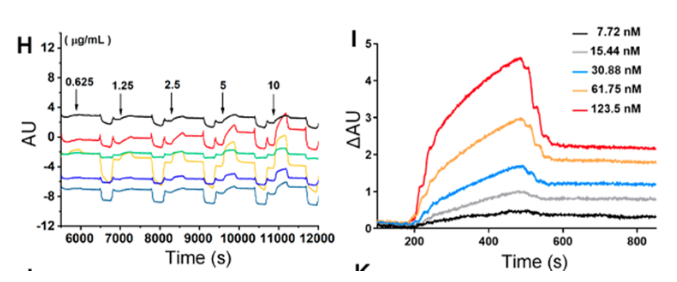
Figure 1h- SPRi affinity comparison of six peptides.
Figure 1i- SPRi affinity measurement of Pep-NfL.
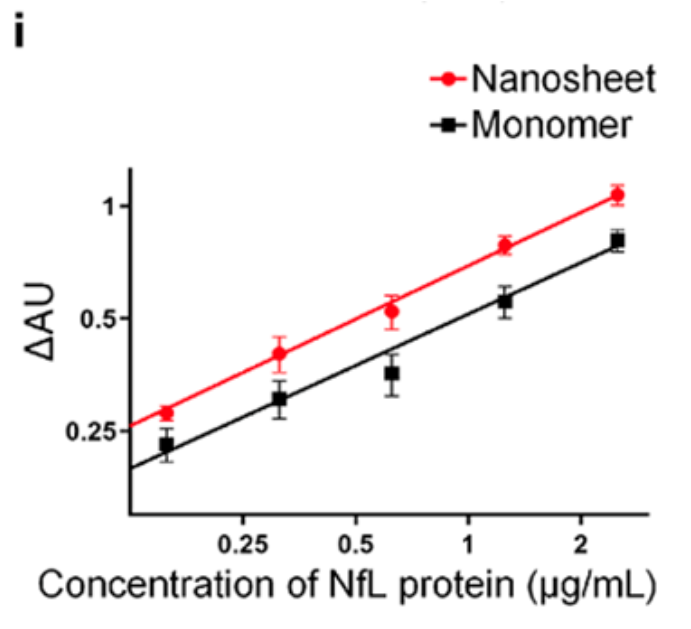
Figure 2i- Comparison of binding signals between nanosheets and monomers.
06 Technological innovation and clinical significance
Compared with traditional antibody detection, self-assembling peptides have the advantages of low cost, high stability and easy large-scale production. The development of Pep-NfL nanosheets not only overcomes the problem of large differences between antibody batches, but also realizes rapid screening and multi-dimensional analysis through microarray chips. Clinical data show that Pep-NfL can track the dynamic changes of plasma NfL concentrations and is expected to become an alternative endpoint for evaluating the therapeutic effect of AD. The economy and high sensitivity of this technology have opened up new prospects for the early diagnosis and long-term monitoring of AD.
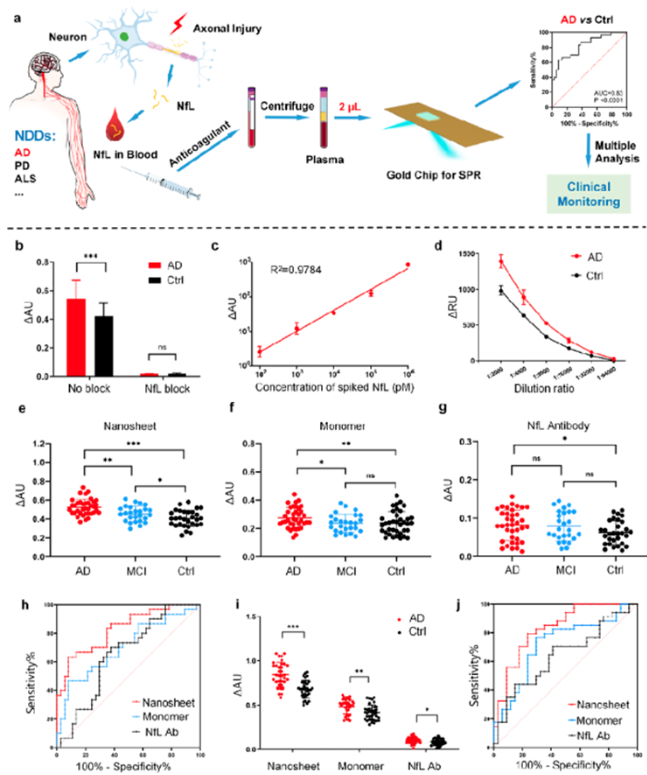
Figure 4 Evaluation of the specificity and sensitivity of plasma self-assembling peptides in detecting Alzheimer's disease (AD).(a) Schematic diagram of non-invasive monitoring of AD from plasma samples based on Pep-NfL; (b) SPRi analysis of the binding affinity of Pep-NfL to NfL in the plasma of AD patients and normal controls, with or without NfL protein as the mobile phase; (c) Signal response of Pep-NfL to human plasma spiked with different concentrations of NfL; (d) Signal response of Pep-NfL to plasma of AD patients and healthy controls at different dilution ratios; (e) Using Pep-NfL peptide nanosheets as probes, the binding signals of AD patients (n=37), mild cognitive impairment (MCI) patients (n=26) and control individuals (n=30) were detected; (f) Using Pep-NfL peptide monomers as probes, the binding signals of (g) Using anti-NfL antibody as a probe, the binding signals of AD patients, MCI patients and control individuals were detected; (h) ROC analysis showed the discriminative efficacy of peptide nanosheets, monomers and anti-NfL antibodies in distinguishing the plasma of AD patients from that of normal controls; (i) Using Pep-NfL peptide nanosheets, Pep-NfL peptide monomers and anti-NfL antibodies as probes, the binding signals of 5×FAD mice (n=34) and wild-type C57BL/6 mice (n=34) were detected; (j) ROC analysis showed the discriminative efficacy of peptide nanosheets, monomers and anti-NfL antibodies in distinguishing the plasma of 5×FAD mice (n=34) from that of wild-type C57BL/6 mice.
07 Summary
This study screened out Pep-NfL through microarray chip technology, providing an innovative solution for non-invasive monitoring of AD. Gold and silver chips are used as chip substrates, combined with the high-throughput analysis capabilities of the Plexera HT instrument, which greatly improves screening efficiency and detection accuracy. This is not only a technological breakthrough, but also an important step towards early intervention of AD. In the future, with the further optimization and promotion of this technology, we may usher in a new era of AD with earlier detection and better management.
Reference Zhou, Y., et al. ACS Nano 2024, 18, 18160-18175. DOI: 10.1021/acsnano.3c09642


