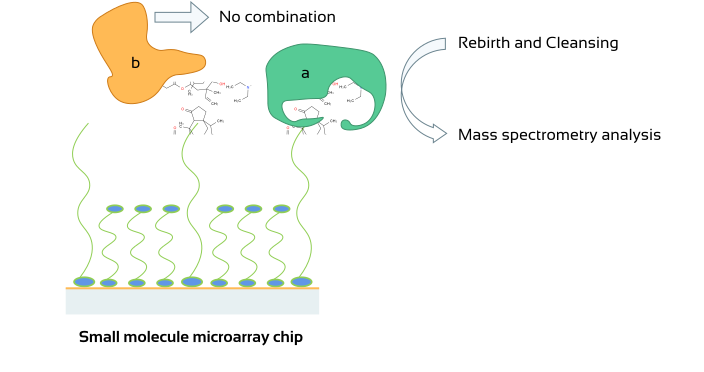
Target fishing is a technique used to identify the protein targets of small molecule compounds, revealing their interactions with biomolecules (such as proteins, nucleic acids, etc.). Through target fishing, researchers can elucidate the mechanisms of action of compounds, assess potential side effects, and discover new therapeutic targets.
The challenges in target fishing primarily include the need for labeling small molecule drugs in traditional methods and the elimination of non-specific adsorption, as well as maximizing the retention of small molecules in a free solution-like state to preserve their native conformation.
The chips developed by Plexera can efficiently immobilize small molecules in a non-group-selective manner with strong resistance to non-specific adsorption, making them highly suitable for target fishing applications.
Experimental Procedure
Microarray chip preparation
Choose a suitable chip. The small molecule compounds used as bait are densely spotted onto functionalized solid surfaces to form the small molecule microarray.
Sample injection
Flow the cell lysate (as the sample) over the microarray formed by the bait small molecule compounds.
Collect the target protein
The elution buffer containing the captured target protein is collected for downstream analysis (e.g., mass spectrometry identification).
Mass Spectrometry (MS) Analysis
The collected elution buffer containing captured proteins is subjected to mass spectrometry (MS) analysis (e.g., LC-MS/MS) to identify the protein targets and obtain detailed information such as molecular weight, sequence, and post-translational modifications.
Advantages
Highly efficient and non-group-selective immobilization of small molecules, which supports broad compatibility with diverse chemical structures and significantly reduces the false negative rate by enhancing immobilization yield and efficiency.