Drug Screening
Basic Principles
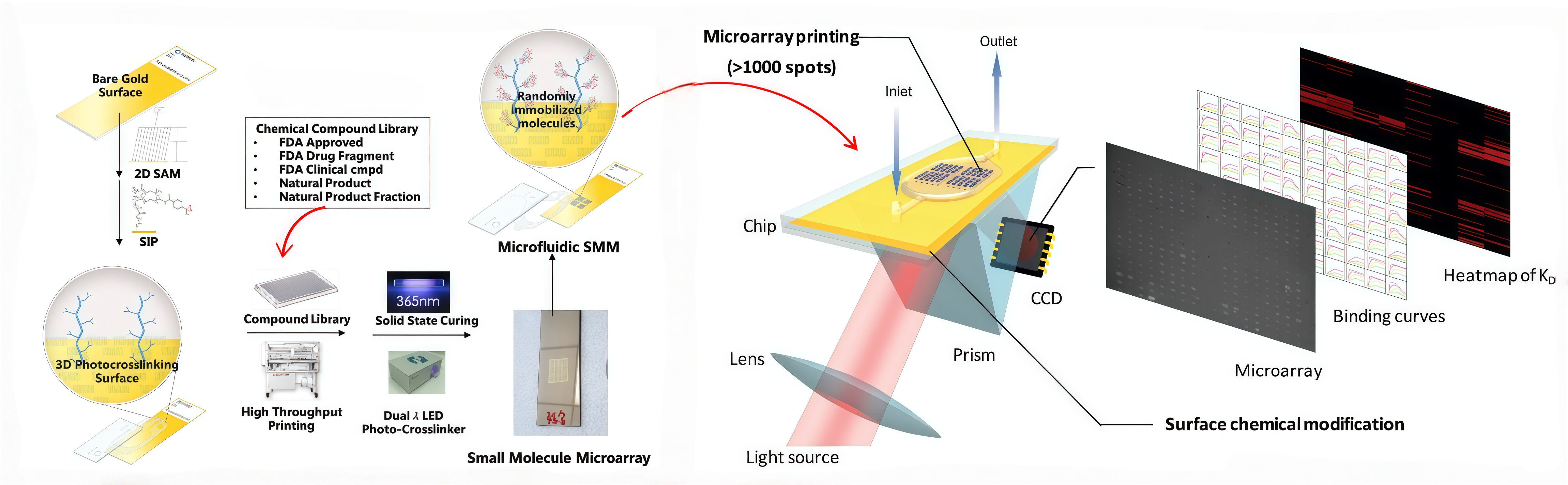
Small Molecule Microarray (SMM) is a high-throughput screening technique used to study interactions between small molecules and biomolecules, such as proteins and nucleic acids. It involves immobilizing a large number of small molecule compounds on a chip surface, allowing rapid identification of potentially active compounds through binding reactions with target molecules.
Surface Plasmon Resonance (SPR): A label-free technique for real-time monitoring of intermolecular interactions by detecting changes in refractive index caused by molecular binding on the surface. It enables observation of dynamic processes, including association and dissociation kinetics.
The PlexArray® SPRi system combines SMM technology with surface plasmon resonance imaging (SPRi), offering the advantages of high throughput, label-free detection, and real-time monitoring.

Experimental Procedure
  • Preparation of microarray chip
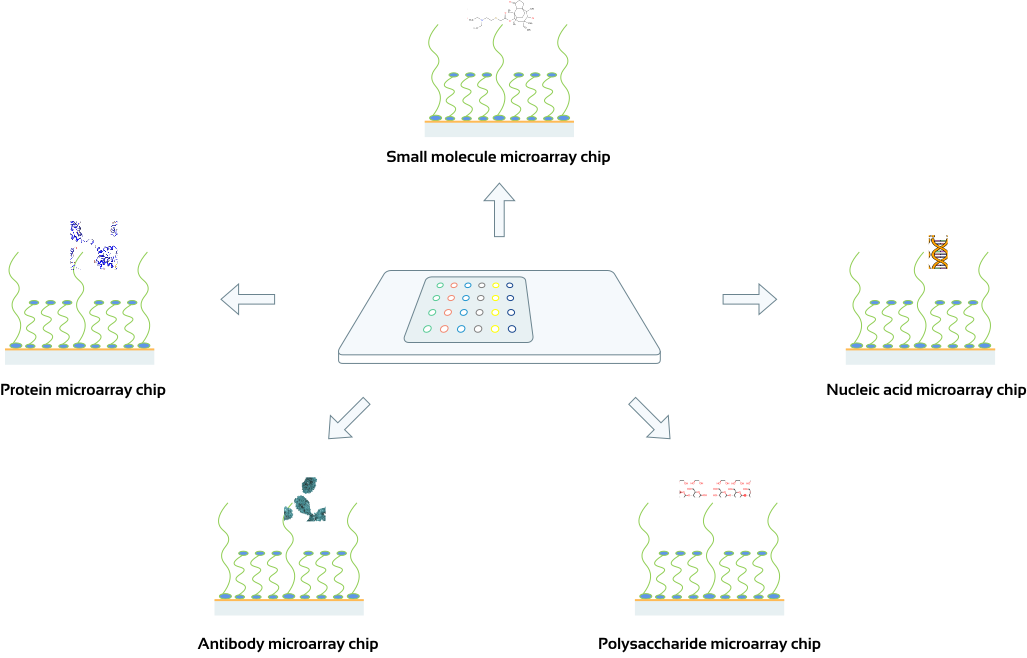
    Choose the appropriate chip. Thousands of small molecule compounds or other samples are densely spotted on solid surfaces to form microarrays.
  • Sample injection
    Inject the target protein (or analyte) into the flow cell. The target molecules flow over the chip surface and bind to the immobilized small molecule compounds, enabling real-time monitoring of binding interactions.
  • Data collection
    Real-time monitoring of SPR signal changes. The system records association and dissociation processes in real time, generating curves for each spot on the microarray.
  • Data analysis
    Analyze kinetic parameters. The system fits the sensorgrams for each spot on the microarray, calculates kinetic parameters, and then ranks and screens them to identify potential hit compounds that exhibit strong binding affinity to the target protein.
Advantages

high throughput

label-free detection

real-time monitoring

Unlabeled detection
No fluorescent or radioactive labeling is required.
Real time monitoring
Can observe the dynamic process of interaction.
High sensitivity
Capable of detecting molecular interactions at low concentrations.
Application scenarios
Rapidly screen potential small molecule drug candidates using pre-existing small molecule compound libraries targeted against the protein of interest (e.g., FDA-approved drug libraries).